Wednesday, April 27, 2011

Counseling for the Second First-Choice

By Patrick J. O'Conner Ph.D.

Is counseling for the unknown an art or a science?

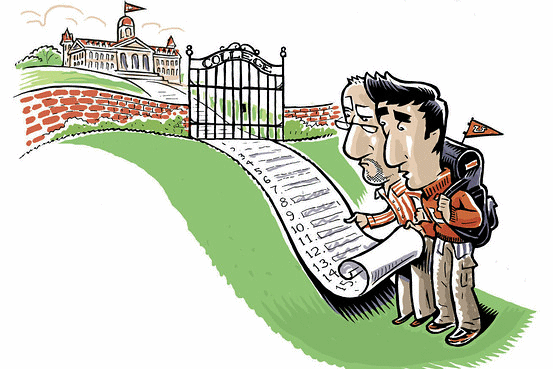
It’s a question that’s plagued our profession for many years, and the dilemma only seems to be getting worse.  The recent round of college admissions decisions left thousands of students and parents (and their counselors) speechless, as acceptance rates at many colleges fell below 7%, with one college—the tuition free Curtis Institute of Music—falling to 3.5%.  That would be an exceptionally strong batting average for a baseball player, but to high school seniors, these numbers sound like there’s a better chance of getting hit by lightning on a sunny day than getting admitted to college.

The same is true for middle school  and elementary counselors.  Tryouts for the 8th grade football team are coming up, and a student is concerned he won’t make the team.  After talking with you, he decides to give it a try, and doesn’t make the cut.  He goes home devastated, telling his parents you talked him into the tryout. 

If his 5th grade sister comes home with the same scenario about not getting the lead in the spring play the counselor “promised’ her, you’ve got one unhappy family on your hands—especially if the oldest child is a high school senior who applied to Curtis and was rejected. In each case, the question is the same—didn’t the counselor see this coming?

The answer is yes and no.  Yes, the counselor knew there were only so many slots for too many students, so some students were going to be disappointed; no, they had no idea which side of the decision your child would be on.  Yes, your counselor could see strengths and weaknesses in your child’s abilities and experiences that could affect their chances of success; no, your counselor has no idea what the strengths and weaknesses of all of the other students are.  Yes, your counselor has probably advised many students about these activities, so they may have some idea of the standards used by those making the decisions; no, these standards are not always consistent from year to year.

Some real-life examples can give parents something to hold on to as they grasp for grounding.  If your son was one of two fast 8th graders to try out for wide receiver, there’s a good chance they’re in; if they’re one of twenty, the chances go down.  If the 5th grade musical always has lots of roles for sopranos, your high-pitched daughter is in great shape, unless the director decides to change things up this year and feature the altos.  If some small college that took everyone last year is the new hot school, there just won’t be room for everyone this year.

The final, essential piece here is developing Plan B before it’s actually needed.  Seniors apply to more than one college in case their top choices don’t work out; lanky wide receiver wannabes are encouraged to think about running cross country if there’s gridlock on the gridiron; elementary coloraturas can set their sights on the church pageant or the community playhouse if the spring play doesn’t work out.

The science of counseling involves discussing facts in ways that offer clear pictures to clients; the art involves creating a host of possibilities the client can feel good about without thinking they’ve settled for second best.  There will always be first choices, and the pains that come from not achieving them, but the beauty of good counseling is that students and their parents will see the opportunities they do earn as second first choices, eager to make the most of them

Thursday, April 14, 2011

On a Scale of 1 to 10, How do You Feel About Evaluating a Counseling Program?

By:  Patrick J. O'Connor, Ph.D.


Don’t look now, but the end of the school year is about two months away.  For counselors, this means awards assemblies, school picnics, and graduation ceremonies for everyone from kindergarten to high school.  But thanks to school improvement programs and state mandates, the long to-do list for May and June may have a new addition—the collection of data to evaluate the effectiveness of your school counseling program.

Hard as it may be, measure we must—data is the lifeblood of most principal’s careers, so it’s time to review some basics for measuring the effectiveness of the department that improves students’ lives:

What do you want to know?  This may seem like an obvious question, but that happens a lot in counseling.  The key is to answer the question in a way that will show key groups (administrators, parents, your teaching colleagues) everything you do—so once you think you’ve answered this question, you’re going to have to run it past these groups to see if your answers make sense to them.

Suffice it to say, if this is the first time all year you’re thinking about this question, it may be time to do some fact gathering and hold off the evaluation until next year.  Bring your stakeholders together, gather some opinions, and begin your plan for 2012; chances are the administration will give you a year to put a quality assessment together, as long as you give them a good reason for the delay—like, you were too busy actually helping students..

How will you measure what you want to know?  Everyone may want to know if the college advising program is successful, but if the parents think the way to measure that is in scholarship monies earned, the principal thinks it should be measured by students going to Harvard, and you think it should be measured by how happy the students are about their college choice, you have a lot of talking to do.  (By the way, never—never—measure a college counseling program by the number of students who were admitted to a college in a given year.  Too many factors are involved that are out of your control; if you don’t believe me, just Google “admissions decisions 2011” and have the smelling salts at hand.) Make sure you reach consensus here, or people may insist you’re trying to hide something.

What will be a satisfactory level of response?  I’m not suggesting you do this, but let’s say you want to measure the counseling program’s stress management program by giving random students a stress level test. What kind of outcome will be considered successful—if the average score is below More Tightly Wound Than Big Ben, or if 75% of the students have lower stress scores than their pre-tests last fall.  Remember, if you decide to go with a pre-test model of some kind and you didn’t do the pre-test levels, let this go until next year—the data you get with post-test only can only be used in wrong ways.

How, and when will you share the results, and with whom?  Once the results are in and analyzed, you can’t keep it secret for long.  Decide now how the information will be shared, remembering that results can be shared in different ways with different groups that have different needs—if this sounds like counseling, you’re absolutely right.

The key here is not to rush into this.  Look at what other schools are doing, make sure everyone has a common sense of purpose, and your efforts will leave everyone happier than the last day of school.

Thursday, April 7, 2011

How to Help Students Deal With College Waitlists

By: Patrick J. O'Connor, Ph.D.


Photo by Lars Leetaru-WSJ Online
The last big round of college admissions decisions have been released, and counselors are very busy helping students and parents understand what it all means. Adding to the confusion this year was a significant increase in the number of colleges putting students on a waitlist—and with good reason.

It’s hard to be a waitlisted student.  On the one hand, you have to plan to attend a college where you’ve been admitted; on the other hand, you have to keep looking at your e-mail to see if another college still wants you. This waiting game can sometimes go on into the summer, and just like the last three months have been hard on all college-bound students, the next two months can be real agony for those students on a wait list.

Counselors can help waitlisted students by asking these simple questions:

If you were called off the waitlist today, would you still want to go to that college?  Since the student applied to the college, you’d think this would be an easy question to answer—but it isn’t.  If a college says “maybe”, the student may think twice about how good of a fit this college is after all, or the student may simply look at the two or three colleges that have said “yes” and decide that’s good enough.  Asking this question can help the student focus on what matters to them now, and that can only help.

What are you willing to do to still show interest in the college?  Colleges sometimes tell waitlisted students to send back a postcard or an e-mail to indicate an interest in staying on the mailing list.  In most cases, this is an unspoken invitation for the student to make another brief contact expressing their interest in the college (check with the college).  A two or three-paragraph update of the student’s achievements and accomplishments since they applied is a great way to show continued enthusiasm, and some students even ask another teacher for an additional letter of recommendation.

These are great communication tools, but they also take time.  With AP and IB tests coming up, not to mention prom and other social events, waitlisted students simply may not have the time or interest in putting this update together.  If all they want to do is return the postcard, that’s great, but it’s fair for them to know other students may not be going quietly when it comes to the waitlist.

Is financial aid a factor?  It’s hard to tell what will happen in this very unusual college admission season, but waitlisted students in past years often found little or no financial aid waiting for them for their first year.  It could be that the student’s interest in the college is so strong they would go anyway, and of course the student may get much more aid in their second year, but students and families should know that a waitlist admit can decrease their chances of getting of getting complete aid.  If this is an issue for the student, have them call the college and ask.

Do they have a Plan A?  This last question is also simple, but important.  A student MUST have a college to commit to come May 1st—without one, they may have nowhere to go come fall.  Be sure to find out.

Waitlisted students have a lot to think about, but these guiding questions can be a huge help in getting students to focus on what matters most as March Madness threatens to extend into May.

Thursday, March 31, 2011

Doing Our Work with a Spring in Our Step

By : Patrick J. O'Connor, Ph.D.

April is indeed the cruelest month for school counselors.  While it’s wonderful to hear the birds singing and to see some flowers in bloom, this is the time of year when our workload is at its busiest, no matter what grade level we serve:

*   Counselors at all levels are leading their schools through required standardized testing;
*   Middle and high school counselors are working with students on schedules for next year;
*   Elementary counselors are dealing with students who have simply had it with winter;
*   High school counselors are doing some major hand-holding to support seniors disappointed with college decisions

Taken individually, these tasks might be manageable—but add them all together, throw in a request to make a presentation to the school board or chaperone a basketball game, and this is more than enough to put you over the edge.

This kind of frustration is common among teachers, so what is it that seems to make it so acutely felt by counselors?

Because we are the integrity center for our schools.

Think about it.  When a student mouths off in class and the teacher asks them to stop, does the counselor see that student if they do as their told?  Of course not; we only see the students who talk back to the teachers, so we can help the student sort out their priorities and consider their behavior.

If a senior decides to drop an Advanced Placement class for a gym class, who has to tell them they have to report this class change to the colleges where they’ve been admitted?  Right—us.

Who’s called in to mediate a tense principal-parent meeting?  Who’s asked to come to the Spanish class and explain the importance of learning a language other than English?  Who is supposed to help every student grow every day?

No wonder we’re tired.  When it comes to taking a stand on an issue, we spend more time on our principled feet than the Statue of Liberty.

What’s the best way to catch a breather and stay standing tall?  Let’s practice what we preach, and remember these three things:


*   Keep the big picture in mind.  Talking with Joey again about his failing report card may not get him to leave your office as a changed person, but it may give him something to think about tonight, or this weekend when he’s deciding if he should do his homework.  We are Johnny Appleseed, planting ideas for growth in life, and they might not be hydroponics; give them the support and time they need to grow.
*   Consider the alternative.  Leading the charge for right over wrong may seem more like working in the Alamo than a counseling office, but the two can have much in common if we remember the importance of principle and commitment.  It’s what we want the students to demonstrate, so these are our behaviors to model.
*   Cherish the victories.  With the enormous caseloads we carry, there has to be at least a dozen students a day who show some kind of personal growth.  Focusing on the 400 who don’t seem to get it yet will keep us depressed, and won’t help anyone grow; be prepared to yell, whistle, and high five every piece of good news that comes your way.

April showers may bring May anxieties about who’s taking who to the big spring dance, but if we follow our own advice and are good to ourselves, the growth of all things dormant since the winter won’t be the only beautiful signs to dot our landscape in the next two months.
Patrick

Thursday, March 24, 2011

Helping Kids by Supporting Their Parents

Patrick J. O'Connor, Ph.D.

School counselors everywhere will appreciate the strong, data-driven reminder delivered in a February editorial in The Christian Science Monitor. “Want better students? Teach their parents” is aimed at classroom instructors, reminding them that many parents don’t know how to help their children build good study habits—but they are willing to learn.  This article stands apart from others like it because is offers some research suggesting the coaching of parents makes a difference with children, further evidence that much of what goes on in the classroom is impacted by what goes on outside the classroom.

If parent support of classroom teachers is important, imagine how vital it is for the teachers outside the classroom—like school counselors.  Our work with students focuses on some of life’s biggest lessons; exploring careers, recovering from loss, preparing for college, and dealing with conflict are only some of the issues in our curriculum, so it’s only logical that parent support of our “teaching” would improve student learning in a number of ways.

There is no single best way to win over parent support—approaches are probably as different as each student and parent we work with.  But if you’re looking for somewhere to start, consider these approaches as you review your work with parents:
  • Communication.  The days of relying on parent conferences and a monthly printed newsletter as the only ways to reach parents are long over.  A strong counseling Web site that’s frequently updated, a short weekly newsletter delivered weekly by e-mail, flyers posted on the community bulletin board at the coffee shop and places of worship, and even Facebook accounts can spread the word about the quality services and programs counselors offer.  No one approach will get to everyone, but every approach will reach someone.
  •  Location.  Gone too are the days of sitting in our offices, waiting for parents to drop by to see if you’re busy (and since you’re always busy, aren’t you glad parents don’t do this anyway?)  A Johns Hopkins researcher once said many parents don’t come to school because it’s the school where they failed as a student; still other parents are just too busy.  It’s time to take your programs and seminars to the coffee shop, the bowling alley, the PTA meeting, the Laundromat—or maybe the school parking lot, where the 5th grade moms meet to gossip.  Think about where parents naturally gather—that’s where you want to be.
  • Collaboration.  You might not draw much of a crowd at the roller rink by setting up a table with pamphlets about your services, but if you get the owner of the roller rink to sponsor a family night with reduced rates and giveaways, your chances of success just got bigger.  Pass out low-cost ink jet business cards, get the DJ to make some brief announcements of your services, and see what your mingling can bring—especially if you lace up the skates and take a turn on the track.
  • Abbreviation.  There’s a good chance you won’t be able to do much in-depth counseling at the bowling alley, and Pastor Mike probably won’t let you take over his entire sermon to talk about every part of your career counseling program.  Make sure your message maintains the right focus and length for the audience and the communication vehicle, and respect, awareness, and involvement in your counseling program will soar.
More good student counseling will occur with good guidance for parents—once they’re on your side, nothing can stop you.
Patrick

Wednesday, March 16, 2011

A Free Counseling Resource That Beats a Pot of Gold

Patrick J. O'Connor, Ph.D.

One of the biggest tasks faced by school counselors is finding the time to develop their counseling curriculum.  Between meeting urgent needs of students and tending to administration-assigned tasks that have little to do with counseling, the idea of “free time” during the day is more ancient than the typewriter, and the follow-up calls and e-mails that keep most counselors in the building long after most teachers have gone home leave little time after school for anything but rest, recovery, and re-energizing for the next day.

It’s understandable why the counseling curriculum can easily take a back seat to more pressing daily needs, but the development, evaluation, and modification of curriculum is an important step in any counseling office.  Not only does curriculum development provide a reliable structure of services families and students count on; it also reminds community members—including classroom teachers—that counseling has a specific set of goals, tools, and methods of evaluation, just like any other department in the school.

When it comes to development of college counseling curriculum, the National Association for College Admission Counseling (NACAC) can help fill the void between the goal of having a curriculum and the reality of having no time to develop one.  The Families, Counselors and Communities Together (FCCT) program represents 27 years of research and practice in guiding families through the entire college admission process, from the important first steps of college awareness, through visiting college campuses, completing applications, making a decision on which college to attend, and the ever-important awareness of how to pay for college and make college affordable.

Many are surprised that FCCT also addresses the important issue of college readiness.  While this topic may be new to some, NACAC has always realized that it is not enough for a student to be admitted to college; a high school student must develop the study skills, discipline, and goal setting strategies needed to complete the college experience with a certificate, diploma, or degree.

College readiness skills are an integral part of FCCT, making it an ideal curriculum for schools that have a large number of families where the student would be the first in the family to go to college.  At the same time, FCCT is presented in a way where families more aware of the college selection process can reaffirm their understanding of the basics of the process and broaden their appreciation for all the college options that exist.

Counselors interested in FCCT will be happy to know NACAC also provides Power Point presentations in English and Spanish that are ready to present to any audience.  In addition, NACAC offers a series of workshops called Guiding the Way to Higher Education designed for families with students in grades 7-8, 9-11, and 11-12.  The program for middle school students is especially important, since it raises awareness about college in a way that provides information without advocating for a specific college, or putting stress on the student.

If this resource wasn’t enough, budget- conscious counselors (and let’s face it, that’s all of us) will be happy to know that all of these tools are free.  FCCT can be printed to your home or office computer and the slide shows can be downloaded to your computer, all without charge.  Just visit 
http://www.nacacnet.org/PublicationsResources/Marketplace/student/Pages/fcct.aspx; if that doesn’t work, go to www.nacacnet.org<http://www.nacacnet.org/>, and use the search box to find FCCT.

It’s tough finding time and money to develop college counseling curriculum, but NACAC saves the day by providing a time-tested program for grades 7-12, all for free. That’s not just the luck of the Irish—it’s a blessing for all.

Thursday, March 10, 2011

The Best Advice When Colleges Say No


By: Patrick J. O'Connor, Ph.D


School counselors know the real March Madness begins next week, when some of the nation’s most selective colleges release their admissions decisions.  As a pre-game warm-up, let’s stick with the facts we’ll need to comfort the Class of 2011

  • Most selective colleges are reporting a huge increase in the number of applications.
  • This increase is due in part to more American students applying to college, and colleges seeking out more students from overseas.
  • Since this also happened last year, many colleges enrolled too many students last fall.  They’ll have to make up for that, so many colleges will be admitting fewer students this year…
  • …and wait-listing more students.  This increase means fewer students will be admitted from the wait list come May—and if they are admitted, financial aid will be scarce.

If none of that does any good, then just say this:

  •  850.

No, this is not the high score on some new version of the SAT, and while it may indeed be the number of times Charlie Sheen appeared on TV last week, that (happily) has nothing to do with college.

850 is the number of valedictorians rejected last year from one of America’s most prestigious colleges.  These students represented the best in their high schools; they did everything they were “supposed” to do—and yet, they didn’t even get to the wait list.

Once you share this with your students, ask them how these 850 students felt when they were rejected.  Sooner or later, the right answer will come forward—“They probably felt like they put in all of that time and effort for nothing.”

And there is the teachable moment.

It had to be hard to be turned down by a school they loved—but did all of that preparation really lead to nothing?  Given everything these students had learned, the many ways they had grown, and how they overcame adversity and embraced creativity in making Plans B, C, and Q, did they really get nothing out of it?

If so, they have every right to be unhappy, but not with the college. They should be unhappy for letting the sun rise and set 1307 times from the first day of 9th grade to the day the college said no, never once appreciating all that each of those days had to offer in and of themselves.

They should hang their heads a little to realize, just now, the difference they’ve made to their classmates, their teammates, and the people they served in the soup kitchen.

And if they look back with a little regret on the many times they blew off a compliment from a parent or a teacher because the goal of college wasn’t realized just yet, that’s more than OK.  They now know it was at that moment that the goal of fully living each day was conquered with a flourish—and understanding that will make each day all the richer at the wonderful college that had the good sense (and room) to take them.

It isn’t easy to see watch wonderful students work through the dismay and disappointment college decisions can bring, but if we remember the most important part of our work has nothing to do with who gets in and everything to do with who gets it, the disappointment will fade faster than the memory of the teams we had in last year’s NCAA pool, and students can move forward with a better sense of who they are, and what really matters.  Now that’s college counseling.